Want to Live Longer? Find Your Tribe

By Brent | Last Updated: March 12th, 2026
Want to Live Longer? Find Your Tribe (2026 Refresh)
"Loneliness kills. It's as powerful as smoking or alcoholism."
– Dr. Robert Waldinger
The biggest thing that made me appreciate community was being without one.
For years, I owned a CrossFit gym. I trained inside a built-in tribe. Same people. Same time. Same shared suffering. Then I got banged up, took time off, and started experimenting with different training styles. Powerlifting. Bodybuilding. Strongman. I learned a lot, and I liked the novelty.
But there was one problem I couldn't ignore. I was doing it alone.
Eventually, I went back to my old gym. The moment I walked in, it felt obvious. Smiling faces I'd missed. Easy conversation. Familiar encouragement. My body still got the workout, but my nervous system got something else entirely: connection.
That experience made me wonder what the research says—beyond the warm and fuzzy stuff. Is community actually linked to living longer? Or does it just feel good?
Turns out, it's both.
Key Takeaways
> Social isolation and loneliness are associated with increased risk of premature mortality comparable to major risk factors like smoking.
> Strong social relationships are linked to approximately 50% higher likelihood of survival in meta-analysis.
> Relationship quality matters more than quantity—a few deep connections outweigh a packed social calendar.
> Social isolation is associated with higher dementia risk and faster cognitive decline.
> Community requires regularity, familiar faces, and mutual support—not one-off events.
Is Loneliness Really a Longevity Risk?
Loneliness is not the same thing as being alone. It's the distress of feeling disconnected, even if people are nearby. The U.S. Surgeon General's advisory defines loneliness as a subjective, distressing experience tied to perceived isolation or lack of meaningful connection—not simple physical solitude.
Here's the sharper point. Social isolation and loneliness are associated with increased risk of premature mortality, on a scale comparable to other major risk factors. That is not poetry. That is a measurable association in large-scale research.
It also shows up in brain health. Social isolation is associated with higher risk of dementia in older adults. If your longevity goal is "more good years," cognitive health is non-negotiable.
Loneliness is also showing up more in developed countries, and the trend line is heading the wrong way.
So yes, loneliness is a real risk. The bigger question is what to do about it.
Quick Answer: Strong social relationships are associated with approximately 50% higher likelihood of survival. Loneliness and social isolation are linked to increased mortality risk comparable to smoking, plus higher dementia risk and faster cognitive decline. Relationship quality matters more than quantity. Building community requires regularity—weekly rhythms with familiar faces, not occasional events.
The Science of Social Connection and Survival
One of the most cited findings in this space is blunt: strong social relationships are associated with a significantly higher likelihood of survival. A meta-analysis found that stronger social relationships were associated with about a 50% increased likelihood of survival.
That does not mean friendships are magic medicine. It means relationships show up as a major predictor when you look at large bodies of data across time.
This lines up with what the Harvard Study of Adult Development has emphasized for decades: relationship quality is a powerful predictor of long-term health and well-being. It's not just that you have people around. It's how you experience those relationships. Do you feel seen? Safe? Supported? Do you have someone to call when life gets messy?
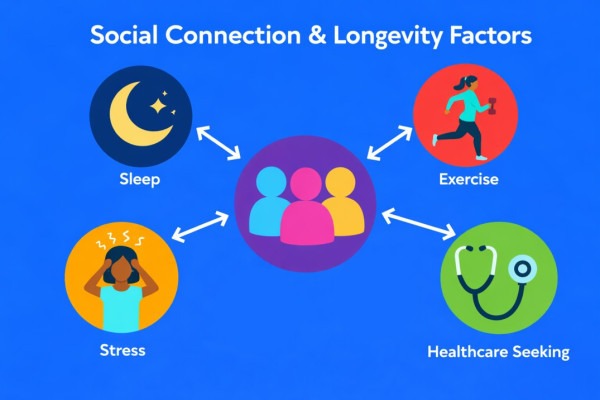
The "why" matters. Relationships affect behavior (sleep, exercise, diet), stress buffering, and the likelihood you seek help early. They also change how your body responds to life. Connection can make stress more tolerable. Isolation can make everything feel heavier.
If you want a longevity lever that touches almost everything else, this is it.
What the Blue Zones Get Right About Community
Blue Zones get oversimplified online. People fixate on one food, one drink, one supplement. That misses the point.
The recurring pattern across many longevity-rich cultures is social architecture. People live in ways that make connection automatic. Meals are social. Walking is social. Ritual is social. Older adults are not treated like optional furniture.
The lesson is not "move to a Greek island." The lesson is design. If your environment makes connection easy, you get consistent social contact without needing heroic willpower.
That's why modern life is such a trap. Convenience quietly deletes friction—and it also deletes people. Deliveries replace errands. Streaming replaces gatherings. Work becomes remote. Exercise becomes solo. Your calendar gets efficient, and your life gets isolated.
If your plan is to outlive your peers, you need to rebuild the social scaffolding that modern life strips away. Not with one-off events, but with weekly rhythms that keep you anchored.
Connection is not a luxury feature. It's core infrastructure.
For a practical test of how your lifestyle stacks up, try our 20-question longevity test based on Blue Zones research.
Quality vs. Quantity of Relationships
More people do not automatically mean less loneliness.
You can have a packed social calendar and still feel isolated if your relationships are shallow, performative, or draining. You can also have a small circle and feel deeply connected.
The research emphasis keeps pointing toward relationship quality, not raw volume. The Harvard Study of Adult Development has been consistent on this theme: close, supportive relationships predict health and well-being over time.
So what counts as quality?
|
Quality Marker |
What It Looks Like |
|
Reliability |
You can count on them when it matters |
|
Emotional safety |
You can be honest without punishment |
|
Mutuality |
It's not a one-way help desk |
|
Presence |
You feel better after, not worse |
It's also normal for this to change by season. Young kids, caregiving, relocation, health issues, career chaos. Your "tribe" might shrink for a while. The goal is to avoid long-term social drift where months go by with no meaningful connection.
If you only take one thing from this article, take this: aim for a few relationships that are steady and real.
The Biology of Loneliness
Loneliness is not just a feeling. It can spill into physiology.
The Surgeon General's advisory links loneliness and social isolation with a higher risk of cardiovascular disease, dementia, stroke, depression, anxiety, and premature death. Those are not minor outcomes.
There's also a systems effect. Loneliness tends to disrupt sleep, reduce activity, and worsen mental health—which can create a feedback loop that gets harder to exit the longer it runs. The CDC also highlights how loneliness can affect mental and physical health, including sleep and immune function.
It's not always obvious when you're in it. People don't label it "loneliness." They call it busy. Or tired. Or unmotivated. Or just "getting older." Sometimes it's none of those. Sometimes it's disconnection doing what disconnection does.
The fix is not more screen time with strangers. It's a structured, real-world connection that repeats often enough to matter.
This connects to inflammation research as well—chronic loneliness is associated with elevated inflammatory markers, which ties into broader aging mechanisms.
How Do You Build Your Longevity Tribe?
You do not need to become an extrovert. You need repetition.
The key difference between a community and a hobby is regularity. Communities have scheduled contact and familiar faces. That's where trust forms.
Here are four practical "tribe types" that cover most people:
1) Fitness Communities
Group training, walking clubs, martial arts, yoga studios, hiking groups. Fitness tribes work because you show up on a schedule, struggle together, and build social glue fast.
This is one reason HIIT classes and contrast therapy facilities build such loyal communities—shared discomfort accelerates bonding.
2) Religious or Spiritual Communities
You don't need to agree on everything. You need shared ritual and shared service. These communities are often built for support through hard seasons, not just good ones.
3) Professional Communities
Industry groups, coworking circles, masterminds, and trade associations. Done right, these are not just networking. They are belonging plus shared mission.
4) Intentional Communities
Cohousing, co-ops, eco-villages, and other designs that make daily connection easier. Longevity retreats can also serve as entry points to these networks.
The Simple Starting Play
If you want a practical on-ramp:
> Pick one group that meets weekly
> Commit for 8 weeks (minimum viable duration for relationships to form)
> Talk to the same 3 people each time
> Offer help to someone once
That is enough to start building something real.
What Makes a Community Different?
Communities are not events. They are not one-off meetups. They are not follower counts.
A community has:
|
Element |
Why It Matters |
|
Regularity |
You show up repeatedly; familiarity builds trust |
|
Relationships |
You see the same people and build rapport over time |
|
Service |
You give and receive support; mutual investment creates belonging |
That last one matters more than people think. Helping others is a fast track to belonging because it creates mutual investment.
If your sleep, fitness, nutrition, and mental health are dialed in but you're doing all of it in isolation, you're leaving a big longevity lever untouched.
Find your tribe. Then protect it like it's part of your protocol.
Social Connection and Cognitive Health
The dementia connection deserves special attention.
Social isolation is associated with a higher risk of dementia in older adults, and social engagement is linked to slower cognitive decline. This makes social connection one of the practical ways to protect cognitive function as you age.
The mechanisms likely include:
> Mental stimulation from conversation and shared activities
> Stress buffering (chronic stress damages hippocampal volume)
> Better sleep and activity patterns
> Earlier help-seeking when problems arise
This is why "find your tribe" isn't just feel-good advice. It's a healthspan intervention with real downstream effects on brain function.
When Connection Feels Hard
Some people read articles like this and feel worse because connection doesn't come easily.
A few reframes that might help:
Social skills are skills. They can be practiced. You don't need natural charisma. You need repetition and tolerance for awkwardness.
Start with structure. Classes, groups, and scheduled activities remove the "should I reach out?" ambiguity. The calendar does the work.
Quality over frequency. One meaningful conversation per week beats five shallow ones. Depth matters more than volume.
Small gestures compound. Remembering names, asking follow-up questions, offering help—these are the building blocks.
If social anxiety or depression is making connecting feel impossible, that's worth addressing with a professional. A longevity-focused physician or mental health provider can help clear obstacles that make the community feel out of reach.
Frequently Asked Questions
Does loneliness shorten your lifespan?
Loneliness and social isolation are associated with increased risk of premature mortality in large-scale research. The relationship is complex, but the association is consistent across many studies.
How does social connection affect longevity?
Stronger social relationships are associated with approximately 50% higher likelihood of survival, and relationship quality predicts long-term health and well-being in longitudinal research (Harvard Study of Adult Development).
How many close friends do you need for health benefits?
There is no magic number. Relationship quality is a more important pattern in the evidence base, and supportive relationships are tied to better long-term outcomes.
What is the difference between loneliness and being alone?
Loneliness is subjective distress from an inadequate meaningful connection. You can feel lonely in a crowd, and you can feel connected with a small circle (U.S. Surgeon General).
What are Blue Zones, and what do they teach us about community?
Blue Zones are regions often associated with higher longevity. A common theme is a social structure that makes connections frequent and default, not occasional. Take our 20-question Blue Zones longevity test to see how you compare.
How can I build a stronger social network as I age?
Start with one weekly group you can attend consistently, ideally one that's values- or activity-based. Regularity and familiar faces matter more than novelty.
Does social isolation increase dementia risk?
Social isolation is associated with a higher risk of dementia in older adults, and social engagement is associated with slower cognitive decline. See our guide on improving cognitive function for more strategies.
Can online communities replace in-person connections?
Online connection can help, but loneliness is about the quality of connection, not just contact. Many health outcomes tied to isolation are associated with real-world disconnection, so aim for at least some recurring in-person relationships when possible.
What are the early signs that you might be socially disconnected?
Less frequent meaningful conversations, fewer invitations, a reduced sense of belonging, and long stretches without shared activity. The CDC notes loneliness can impact mental and physical health systems, including sleep and immune function.
How does social connection compare to other longevity factors?
Social connection influences multiple longevity factors simultaneously—sleep, exercise adherence, stress management, and healthcare seeking. It's a "force multiplier" that makes other interventions more sustainable.
Social Relationships and Mortality Risk: A Meta-analytic Review (PLOS Medicine)
Loneliness and Social Isolation as Risk Factors for Mortality (PubMed)
Harvard Study of Adult Development
U.S. Surgeon General Advisory on Social Connection
Social Isolation and Dementia Risk (PubMed)
Social Connections and Loneliness Trends (Our World in Data)
Bilingualism and Cognitive Reserve (PubMed)
About the Author