Red Light Therapy Benefits for Longevity

By Brent | Last Updated: March 17th, 2026
Red Light Therapy Benefits for Longevity (2026 Refresh)
Red light therapy sounds like sci-fi wellness. Stand in front of a glowing panel, fix your mitochondria, and walk away younger.
Some of that is hype. Some of it is real.
Red light therapy, often called photobiomodulation (PBM) or low-level light therapy (LLLT), uses specific wavelengths of red and near-infrared light to trigger biological responses in cells. It's been studied for decades, has a decent safety profile when used correctly, and it's one of the few "biohacks" that actually has a plausible mechanism plus human data.
The important part is expectations. PBM isn't a longevity cheat code. It's a tool. Like exercise or sauna, it's about consistent, sane dosing and matching the tool to the outcome you want.
Key Takeaways
> Red light therapy works primarily through mitochondrial mechanisms involving cytochrome c oxidase and ATP production.
> The strongest evidence supports skin quality, wound healing, and inflammation modulation.
> Promising but more variable evidence exists for brain function, sleep, and cerebral blood flow.
> PBM is generally low-risk when used within appropriate parameters.
> Consistency and conservative dosing matter more than "more is better" approaches.
What Is Red Light Therapy?
Red light therapy is the use of red and sometimes near-infrared light on tissue to influence cellular function. You'll see it delivered through:
> Full-body or half-body panels
> Face masks
> Spot treatment devices
> Wraps and belts for joints or muscles
Most consumer devices sit in the general neighborhood of red light around 630–670 nm and near-infrared around 810–850 nm (brands vary). The light is not UV. It's not trying to burn or damage the skin. The goal is signaling, not tanning.
For device recommendations, see our guide to the best red light therapy devices, or browse our red light therapy marketplace for clinic and home options.
Quick Answer: Red light therapy (photobiomodulation) uses specific wavelengths to influence mitochondrial function and cellular signaling. The strongest evidence supports skin quality, wound healing, and inflammation modulation. Promising research exists for brain function and sleep. PBM is generally safe when used appropriately and works best with consistent, conservative dosing rather than aggressive protocols.
How Does Photobiomodulation Work?
PBM is best understood as a mitochondria-first story.
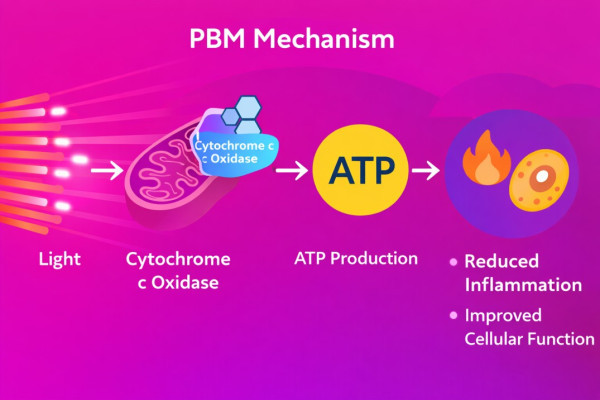
A commonly described mechanism is that red and near-infrared light interact with cytochrome c oxidase in the mitochondrial respiratory chain, which can support mitochondrial respiration and ATP production under certain conditions.
From there, downstream effects may include shifts in oxidative stress signaling and inflammation-related pathways. There's supportive evidence that PBM can reduce oxidative stress and inflammatory markers across tissues in a range of models and clinical contexts.
This is why PBM keeps getting framed as "cellular health" support. If mitochondria function better and the inflammatory load drops, a lot of age-related issues become easier to manage. Not magically cured. Easier to manage.
The Mitochondria Connection
If you care about longevity, you care about mitochondrial function. Aging is messy, but mitochondrial decline shows up again and again as a contributor to reduced resilience.
PBM's appeal is that it can nudge mitochondrial respiration and ATP production through well-described photochemical interactions.
That said, more ATP on paper does not automatically mean longer life. Longevity outcomes are hard. What we can say with more confidence is:
> PBM has mechanistic plausibility for supporting cellular energy production
> PBM has evidence for reducing inflammatory signaling in multiple contexts
> Those two themes are relevant to healthy aging, even if they do not "prove longevity"
If you want to treat PBM like a longevity tool, treat it like you treat Zone 2 cardio. It supports the base layer. It's not the whole building.
For a broader framework on how these tools fit together, see our guide to longevity.
What Does the Research Actually Show?
PBM research is wide. The strongest human evidence tends to cluster around a few outcomes:
Skin Quality and Collagen Support
There's evidence that PBM can improve skin texture and collagen density, and support aspects of wound healing and skin recovery. This is the most cosmetically visible benefit and one of the most studied.
Wound Healing and Tissue Repair
Low-level light therapy has been studied for accelerating wound healing and tissue repair, including post-injury recovery contexts. Athletes and those recovering from surgery often use PBM for this purpose.
Brain and Cognition-Adjacent Outcomes
Transcranial PBM has research suggesting potential benefits for cognitive and neurological function, depending on population and protocol. Near-infrared light has also been studied for increasing cerebral blood flow and oxygenation, which is part of the reason brain applications stay in the conversation.
For more on protecting cognitive function, see our comprehensive guide on ways to improve cognitive function.
Sleep and Circadian Biology
There's human research suggesting red light exposure may improve sleep quality and melatonin profiles in specific contexts. We've covered this in depth in our article on red light therapy and sleep.
This isn't "proof of longevity," but it's a real set of effects that map to healthspan domains: skin integrity, recovery capacity, brain resilience, and sleep quality.
Red Light Therapy Benefits Ranked by Evidence
This is the clean way to think about it. What's most supported, and what's more speculative?
|
Evidence Tier |
Benefit Category |
Key Citations |
|
Stronger Evidence |
Skin texture, collagen support, cosmetic outcomes |
|
|
Stronger Evidence |
Wound healing and tissue repair |
|
|
Stronger Evidence |
Inflammation and oxidative stress modulation |
|
|
Promising but Variable |
Brain-focused PBM, cognitive measures |
|
|
Promising but Variable |
Cerebral blood flow and oxygenation |
|
|
Promising but Variable |
Sleep and circadian outcomes |
If you're using PBM for longevity, anchor on the strongest buckets first: recovery, inflammation management, and sleep support.
How Should You Use Red Light Therapy for Longevity?
Most people get tripped up here because they think "more is better." PBM does not behave like that.
Your best approach is boring and consistent:
> Start with conservative sessions
> Track your response for 2–3 weeks
> Adjust slowly
If you're using a panel, distance and time matter because they change the delivered dose. If you're using a mask, the dose is usually pre-baked but still not immune to overuse.
Watch for Rebound Symptoms
A simple way to sanity-check your protocol is to watch for these signs you went too hard:
> Headaches
> Feeling wired at night
> Skin irritation
> Sleep disruption
If those show up, you went too hard or too late in the day. Pull back.
Safety-wise, PBM is generally reported to have minimal adverse effects when used within guidelines and appropriate dosing parameters.
Practical Protocol Framework
|
Goal |
Device Type |
Session Timing |
Frequency |
Notes |
|
Skin quality |
Face mask or panel |
Morning or early evening |
3-5x weekly |
Most consistent evidence |
|
Recovery support |
Panel or wrap |
Post-workout or evening |
After training |
Watch for sleep interference if late |
|
Sleep support |
Red light only |
30-60 min before bed |
Daily |
Avoid near-infrared close to bed |
|
Brain/cognitive |
Panel (transcranial) |
Morning |
2-3x weekly |
Most variable evidence; be conservative |
For detailed device comparisons, see our best red light therapy devices guide.
Choosing a Red Light Device: What Actually Matters
The market is chaos. Everybody claims they have the magic wavelengths and the "clinical dose."
Here's what matters in real life:
|
Factor |
Why It Matters |
|
Use case |
Face/skin, joint pain, muscle recovery, or full-body routine? |
|
Consistency |
A device you'll actually use beats a "perfect" device you won't |
|
Coverage |
Bigger panels are easier for full-body habits |
|
Comfort |
If it's annoying, you'll stop |
|
Wavelength transparency |
Brand should clearly state nm ranges |
For longevity-adjacent goals, full-body consistency tends to win. Skin-only devices are fine, but they're narrower in impact.
Browse our red light therapy marketplace to compare options, or explore longevity clinics that offer professional-grade PBM setups.
Red Light vs. Near-Infrared vs. Infrared
These get mixed up constantly.
|
Type |
Wavelength |
Penetration |
Primary Use Cases |
|
Red Light |
~630-670 nm |
Surface-level |
Skin, collagen, cosmetic outcomes |
|
Near-Infrared (NIR) |
~810-850 nm |
Deeper penetration |
Muscle, joints, brain-directed protocols |
|
Infrared (heat-based) |
Longer wavelengths |
Heat effect |
Sauna, heat therapy |
Red light is typically used more for surface-level applications like skin outcomes, though it's not limited to that.
Near-infrared (NIR) generally penetrates deeper than visible red light and is commonly used in discussions around muscle, joints, and brain-directed protocols. NIR is tied to findings like cerebral blood flow and oxygenation changes in some studies.
Infrared (heat-based exposure) is a different category. That's more sauna and heat therapy territory. It's not the same intervention as PBM, even if some products blur the line in marketing.
If a company can't explain this clearly, that's a brand red flag.
How Red Light Therapy Fits with Other Longevity Tools
PBM works well alongside other recovery and cellular health interventions:
Heat therapy: Different mechanisms, complementary effects. Sauna works through heat shock proteins; PBM works through mitochondrial signaling.
Cold therapy: Some people alternate. Cold for stress adaptation; red light for recovery support.
Contrast therapy: PBM can be added as a third modality in a heat/cold routine.
Sleep optimization: Red light before bed may support melatonin and sleep quality.
The key is consistency and not stacking too many variables at once. Add one thing, assess for 2-3 weeks, then consider adding another.
Is Red Light Therapy Safe?
Used appropriately, PBM is generally considered low risk with minimal adverse effects reported in the literature, especially compared to many other "longevity gadgets."
That doesn't mean it's for everyone, and it doesn't mean you can ignore common sense.
Talk to a clinician first if you have:
> Active skin disease or photosensitivity conditions
> Medications that increase light sensitivity
> History of seizures (for transcranial applications)
> Eye conditions (always use appropriate eye protection)
If you're aiming at brain-directed PBM, be extra conservative because protocol variability is a big deal in that research area.
Consider consulting a longevity-focused physician if you want personalized guidance on integrating PBM into your protocol.
Finding Red Light Therapy
Home options:
> Browse our red light therapy marketplace
> See our best red light therapy devices guide for comparisons
Professional options:
> Longevity clinics often include PBM
> Many IV therapy centers now offer red light
> Some cryotherapy facilities have integrated panels
Frequently Asked Questions
Does red light therapy help with aging?
It may support aging-related outcomes like skin quality, inflammation modulation, sleep, and recovery capacity. The strongest evidence clusters around skin and tissue repair effects.
How does red light therapy work?
It's a form of photobiomodulation. Red and near-infrared light can influence mitochondrial respiration and ATP production via mechanisms involving cytochrome c oxidase.
What is photobiomodulation?
Photobiomodulation is the use of specific light wavelengths to trigger biological responses in tissue. It's been studied for effects on inflammation, oxidative stress, and cellular energy dynamics.
How often should I use red light therapy?
Frequency depends on your device and goal. Many people do best starting conservatively (3x weekly) and increasing slowly while monitoring sleep, skin response, and recovery. PBM is generally low risk within sensible use guidelines.
What is the best red light therapy device?
"Best" depends on your goal. Face masks are convenient for skin outcomes. Panels are better for full-body consistency. See our best red light therapy devices guide for comparisons.
Is red light therapy safe?
When used within recommended parameters, PBM shows minimal adverse effects in published research.
What is the difference between red light and infrared therapy?
Red light is visible and often used for skin-focused outcomes. Near-infrared is not visible and tends to penetrate deeper, with research including cerebral blood flow and oxygenation effects. Infrared "therapy" is often heat-based (sauna), which is a different intervention category.
Can red light therapy help brain health?
Transcranial PBM has research suggesting potential benefits for cognitive and neurological function, but outcomes vary by protocol and population. See our guide on improving cognitive function for more strategies.
Can red light therapy improve sleep?
There is evidence red light exposure may improve sleep quality and melatonin profiles in certain settings. See our article on red light and sleep for details.
Should I use red light therapy before or after a workout?
Most research on recovery uses PBM after training. Some protocols use it before for pre-activation. Start with post-workout if recovery is your goal.
Cytochrome c oxidase and mitochondrial respiration (PubMed)
PBM effects on oxidative stress and inflammation (PubMed Central)
Skin texture and collagen improvement (PubMed)
Wound healing and tissue repair (PubMed)
Transcranial PBM and cognitive function (PubMed Central)
Near-infrared light and cerebral blood flow (PubMed)
Red light and sleep quality (PubMed)
PBM safety profile (PubMed)
About the Author